
PERSONAL WORKS
2016-17
I first made the decision to produce paintings digitally towards the end of the 2016-17 Academic Year. This decision was informed primarily by the an understanding of the tools most commonly used to produce the kind of works I wanted to create; pieces that I felt held an inherent, implied narrative, particularly focusing on the Fantasy and Sci-Fi genres. The vast majority of this early study of the medium was focused purely on simply learning to use the tools and software associated with it. This unfortunately led to a relatively high time requirement for individual pieces and subsequently fewer pieces produced. Despite this, I feel my early works provide great insight into my approach to work at this stage, this being a distinct focus on quality over quantity, which I feel helped me to justify the masses of time sunk into each piece.

2017, Digital Painting, 2000x4000 pixels

2017, Digital Painting, 2000x4000 pixels
2017-18
I continued my development with digital painting in my second Academic Year by first addressing my primary issue with the medium; the time required to produce each piece. I went about this by simply experimenting with producing the most minimalistic but simultaneously readable pieces I could, focusing on composition and colour as well as forms and silhouettes. This experimentation and effort to find a happy medium between quality and quantity culminated in the piece Fear. This piece became, what I feel to be, an emotionally charged, narratively driven work, emphasised by effective composition, a striking colour-palette and gestural brushwork. I then applied this work process to all further pieces.

2018, Digital Painting, 4355x2000 pixels
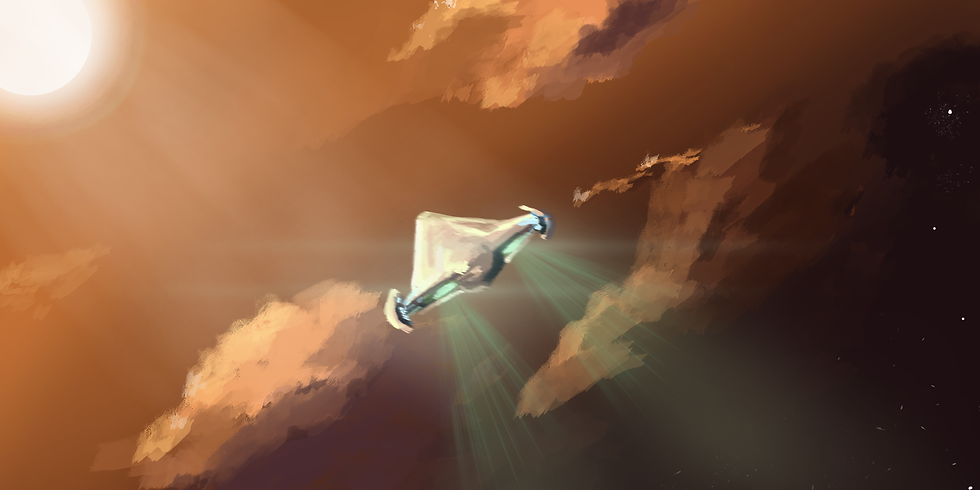
2018, Digital Painting, 4355x2000 pixels

2018, Digital Painting, 4355x2000 pixels

2018, Digital Painting, 4355x2000 pixels

2018, Digital Painting, 4355x2000 pixels

2018, Digital Painting, 4000x2000 pixels

2018, Digital Painting, 4000x2000 pixels

2018, Digital Painting, 4000x2000 pixels

2018, Digital Painting, 4000x2000 pixels

2018, Digital Painting, 4355x2000 pixels
2018-19
The focus at the beginning of my third Academic Year was a desire to implement the 3D modelling skills I had been developing into my personal Practice. As well as affording a chance to further enhance these skills, I felt this decision afforded an opportunity to re-contextualise my work's position as digital media. I planned to achieve this by having the sculpts I created be 3D printed before being assembled as part of a larger exhibit, thereby making what was digital, not only physical but tangible and tactile. The goal of these 3D models would be to reproduce a 2-Dimensional image in 3D space, having the 3D model as the centrepiece while elements such as a backdrop painting and coloured acetate would be layered in front and behind the model to recreate the original image when viewed from a particular angle. The initial target of these reproductions was my own Second Year works, focusing on what I believed to be the most emotive and compelling pieces. I was later convinced to instead attempt to reproduce 2D imagery I myself found iconic, seeing as accurate reproductions of images potentially familiar to any given audience would be that much more impactful.

2018, 3D Head Sculpt, Reproduction of Digital Painting

2018, 3D Head Sculpt, Reproduction of Digital Painting

In Progress 3D Models of the Suits to be used in Fear and Curiosity

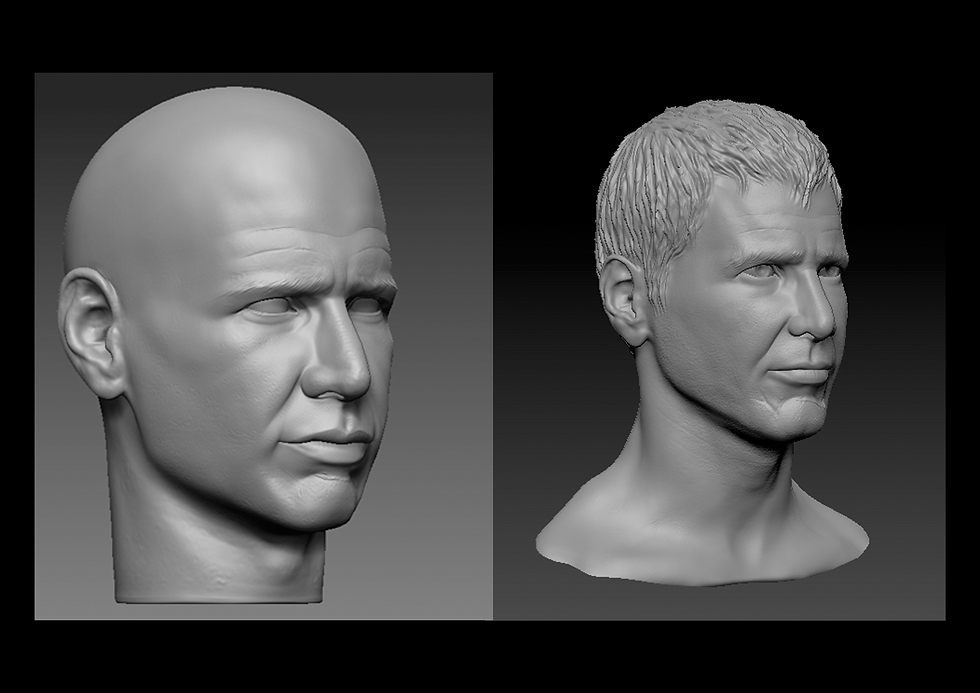
2018, 3D Head Sculpt, to be used in Reproduction of Blade Runner scene

2018, 3D Head Sculpt, to be used in Reproduction of Blade Runner scene
Towards the end of 2018 I found myself feeling highly restricted by the goals I had lain out for myself regarding my practice. The focus in reproducing existing imagery, be it mine or simply imagery iconic to me, was severely hampering the level of creativity and expression I was able to exert in my works. It was for this reason, as well as a desire to return to creating pieces focused on conveying a narrative, that I shifted the goals of my practice in 2019. Desiring to continue developing skills I had accrued during my freelance work and as part of larger projects, I decided to attempt to produce my own animated short. This would allow me to explore conveying a narrative in a far more complete form paired with an even greater emphasis on cinematic language, whereas the length (planned to be between 3 and 8 minutes) and my lack of dialogue preserved the goal of an implied narrative.

2019, Animation, Part of Aisling, 1920x1080 pixels
As it progressed, I found the project changing direction somewhat. With a revised, more emotionally driven narrative I felt I needed to change my approach to the accompanying visuals. Rather than highly saturated, graphic and bold imagery, I elected a much more muted colour palette with a rougher, more hand-painted, almost grimy approach to my mark making as well as the character and environment design. This visual style stemmed primarily from one of the most influential pieces of animation I can remember from my early life; 1978's Watership Down, based on Richard Adams' 1972 novel of the same name. The decision to emulate the film's visuals came from it's own heavy emotional content and how much the imagery and evidence of production enhances the narrative and oppressive atmosphere, particularly during Fiver's visions and Silver's recounting of the warren's destruction at the hand's of Man. The use of a much rougher visual approach had the added fortunate side effect of increasing the rate at which I could produce each of Aisling's 3,960 frames, further hastened by my restriction to a .wmv format and limited resolution. I also wanted to adopt a very industrial approach to the design of the futuristic technology featured in Aisling; I felt it was important that the fact that our main character is working alone to achieve his goal and that the machine he has created has been made by hand was important, especially seeing as it reflects on the project as a whole being a one man production on my part.
2019, Animation, Part of Aisling, 1920x1080 pixels
Ultimately, the project took just over 6 weeks to complete, accounting for the production of the soundtrack and sound effect mixing by Sebastian Bailey, and I feel it achieves the goals set out by my original proposal effectively, telling an emotionally charged story almost purely visually, with no dialogue and any further details about the characters and events other than those shown are merely implied.